Showing posts with label geekery. Show all posts

Wednesday, January 13, 2016

Note, this was written in October. It relates my work as a student with the Living Earth School.
A couple weekends ago, I woke outside to a brisk green morning. Peeking out from the depths of my sleeping bag, my face was greeted by cold air and my vision with the white ashes covering the coals of our overnight fire. Beyond that, a few other friends nestled in sleeping bags around the fire. It was the beginning of the second day of the first weekend of the Living Earth Adult Foundations or LEAF program. Later as we all moved around making our preparations for the day, our instructor Hub appeared with a big branch still covered in leaves. Its reddish brown bark was smattered with small horizontal lines, and the leaves were finely, doubly saw-toothed. He snapped a twig and had us all take a sniff—the refreshing wintergreen smell hit me right in the gut. It’s a smell that warms you in the belly. Hub invited us to come and snap twigs and place them in the kettle, placed on the fire for about 15 minutes, to brew up some Sweet Birch tea.
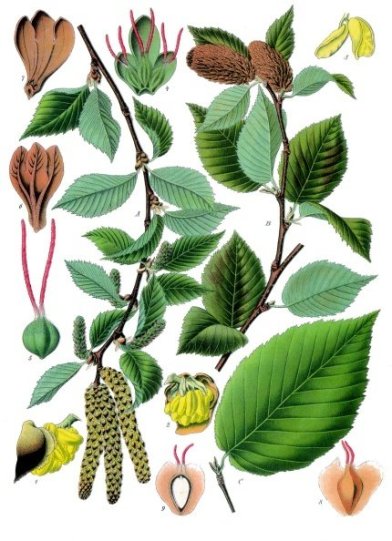
This plant was Sweet B6753817555_f503268444_zirch, betula lenta, also commonly called black birch, cherry birch, and mahogany birch. There is one other birch in our area, bonus points if you can name it in the comments below (a hint: it’s more in the high mountains.) Birch is a profoundly useful tree: the bark was traditionally used in the making of canoes, baskets, and cups. The tar is called the first superglue as well as an early form of chewing gum. The Creek people used birch to treat tuberculosis; the Catawba boiled the buds with sulfur and made a salve to treat ringworm and sores. The Cherokee treated colds, dysentery, and urinary problems with birch tea and by chewing the young leaves. Today, folks laud the teas diuretic and sedative effects in addition to the soothing quality in topical uses—say, for example, that wily case of poison ivy that won’t respond to usual treatments like calamine, jewelweed, and even tannic acid made from boiling acorns (an anecdote from Tom Brown’s Guide to Wild Edible and Medicinal Plants).
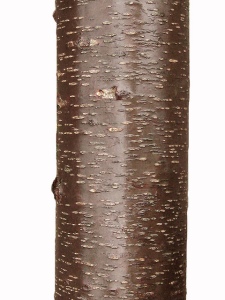
In addition to all this, inBetula_lenta_-_Köhler–s_Medizinal-Pflanzen-021credibly enough, the inner bark can be boiled like noodles or dried and ground to make a flour. The wood burns reliably, even when wet, and can be used as dye for a fawnlike color. A birch feeds birds with a million seeds per year, and is the exclusive host to birch polypore mushroom, which I’ve read is used in finishing the finest edge in sharpening a knife.
While our tea brewed, Hub told us of an elder of his who said that sweet birch just lends a feeling of happiness and well-being. On that cool morning, with that sweet taste, we couldn’t argue with that.
I’ll leave you with this recipe for birch beer from Edible Wild Plants: A North American Field Guide to Over 200 Natural Foods by Thomas Elias and Peter Dykeman:
4 gallons birch sap (tapped in spring, 3-4 after the sugar maples)
1 gallon honey
4 quarts fine twigs
1 yeast cake
Boil honey and sap ten minutes and pour over twigs. When cool, strain and add yeast. Cover and ferment one week or until cloudiness begins to settle. Bottle and cap tightly.

Saturday, April 25, 2015

Web Favorites

Wanted to share some pieces from around the web that I've come across lately and really enjoyed.


First, here's a video piece from an actress, Amandla Stenberg (she plays the lovable Rue in the Hunger Games.) I'm not usually into the idea that hollywood actors should be our go-to experts on stuff, but I really liked what she had to say about cultural appropriation, and she reminded me how important and relevant pop culture is to many of the people in my society, even though I don't actively tend to keep up with pop culture. Kudos, Amandla. https://m.youtube.com/watch?v=O1KJRRSB_XA (image via @msheatherbates)


Next, I thought this piece was uber cool about the needs of new moms as they recover from labor, and, for me, it fits in to a greater conversation about associations of people vs. institutions/delivery systems, http://www.thedailybeast.com/witw/articles/2013/08/15/america-s-postpartum-practices.html (image credit Jaime Razuri via link)


That note about the dichotomy of associations vs. institutions led me on a rampage to dig up something I'd read a couple years ago from Asset-Based Community Development. I've basically been brain-farting this for about two years. It's long, I'm getting ready to re-read it. I remember really liking it, you might too, if you geek for social science and better models. Here are two photos I took of it (which fueled my detective work) and here's the link  http://www.abcdinstitute.org/docs/TwentyFirstCentury-1.pdf


Okay, lastly, brace yourselves, this utterly fascinating piece about ecological anomolies, like osage oranges, and how they were originally food for freakin megafauna. MEGAFAUNA!  https://www.americanforests.org/magazine/article/trees-that-miss-the-mammoths/ (image credit wolfmansf via link)

Monday, April 6, 2015

cob oven: design research

Heya Folks.

One of the things on heavy rotation in the carousel of my brain lately has been a cob oven that we're going to help Holly and Marc build for Moon and Stars Farm this summer. It's pretty fascinating. I find that there's a lot of plans out there, saying, here's how you do it, and then launching into a design that someone thinks is best. I haven't found a good resource outlining the different design decisions to be made yet. Since I'm still in New Orleans, lounging poolside with gin-and-grapefruits and all that, I'm not working with the client yet (Holly) in Virginia about how she actually wants the oven to be, but I'm doing my best to gain an understanding of different models and options and pro's/con's through research.

I'd like to share some of what I've found, broken down by different factors and design decisions. For most of this, I'm deferring to Kiko Denzer, and his online resources, without having actually tracked down his book though I plan to borrow it from a friend soon.

size
K. Here's where you need to start thinking about what you want from your oven. What volume you'll be baking at, frequency, etc. The smaller the space, the quicker and more efficiently it will heat. The larger, the easier it will be to make lots of loaves or pizzas at once. Burning lots of wood to heat a large space to cook a single loaf won't be an efficient use of your resources.  If you are say, feeding a hundred people in your community each day, you'll want a bigger oven for ease. Basic size of an oven is measured in diameter.  Kiko Denzer says that a 21" diameter floor area (inside the oven) "will bake several loaves, smalls pizzas, chickens, etc. and needs less wood and firing time. Our 31 by 23" home oven bakes a dozen 1.5lbs loaves, and 3-4 hours of fire will make two batches of bread, as well as casseroles, turkey, vegetables, soup, beans, etc." His biggest mud oven is at a restaurant, 4x4 ft inside, 9 ft diameter outside.

Though there are plenty of taller ovens out there, they say it's best to cap interior oven height at 16", regardless of diameter. This is because the lower ceiling concentrates steam in the baking area for consistently crusty and lovely loaves.

Another good rule of thumb for body mechanics comfort is to place the oven's floor at about waist high, if you plan to use the oven on a weekly-or-so basis. If you plan to use the oven just once in a while, it may be best for you to place your oven lower so you don't waste energy building up a foundation without receiving regular benefit from your efforts.

shape
The two main shapes I've encountered are the dome/beehive/horno and the Quebec, an ovoid shape. The Quebec is best if you need space for rectangular cookie sheets, or if you want a wide door without having to make a large diameter oven (like for pizza, foccaccia, or cookie trays.) The long shape allows for a wider door without sacrificing a lot of thermal mass.

Another shape point is that it's recommended to have a door height that's 63% of the total dome height. So if you go with the 16", you're looking at a 10.08" door.

chimney vs. no chimney?
Okay, the million-dollar-question. So here's what I've found: there are a couple of schools of thought here. The chimneyless camp builds simple domes and allows the smoke to escape through the door opening. This is the model for the traditional horno ovens in the American southwest. This will absolutely stain the front of the oven with soot. It's also absolutely not appropriate for use indoors. The thinking is as follows: 1. an efficiently burning fire won't make all that much smoke (remember that smoke is unburned fuel escaping. If we build top-down fires we can minimize smoke) 2. A chimney will hemorrage heat during the baking portion, even if plugged. 3. it's simpler to build a chimneyless structure. 4. Most importantly, a chimneyless fire will burn slowly, giving the thermal mass more time to heat per wood used ratio.


traditional horno ovens, NM and AZ

The pro's of designs with chimneys are: 1. Quicker burning fire cuts back on firing time. 2. ease of use (no chance of smoke in face while tending- even if say, you can't bend over to get under the smoke) Of course, if you're indoors, you absolutely owe it to your health to go ahead and build the chimney.

Kiko Denzer, the expert to whom I find myself deferring, puts it like this:

When I first wrote the book I thought chimneys made better ovens because they made a faster, hotter fire. Now I think the traditional oven with no chimney is probably best_if the smoke won’t cause problems. If you need to control smoke, then yes, a chimney is best. I changed my mind after experimenting with a cross-draft oven, which burned well, but used lots of wood. It illustrated a basic fact that I understood, but didn’t quite accept; that is, no matter where you put it, a chimney sucks heat out of the fire. An oven without a chimney burns more slowly, giving the oven mass more time to absorb the heat of the fire.
Other snazzy design details I've seen: an arch built into the foundation to store dry wood (and cut back on stones needed to build up the height of oven floor.) I've also seen some funky models with chimney outlet holes that double as a burner. I think that might be for the advanced cob oven builder. I will also say the cob oven building project is lauded as a really great intro to natural building and can help us gain confidence for bigger cob projects (yeah yeah yeah!) I've bookmarked a bunch of good further reading on a pinterest board (also the sources of the featured images) if you wanna check it out.
figurine of wood fired oven, 500 BCE

I'll close with a really beautiful thought from Kiko Denzer about the role of community ovens in the time immediately following the French revolution. Before the revolution, the French were only baking bread in big ovens under the regulation and ownership of feudal lords. With this new democracy, one of the first things folks did was reassert community control of these big ovens. These ovens represented self-sufficiency, mutual aid, and autonomy at the human level.
"Yes brothers of the plow, the great world must be fed, and heaven gives the power to the hand that holds the bread." - from a song by George F. Root, 1874.

Friday, March 27, 2015

cabin cray cray

Three weeks. After that, headed back to live in this tiny, crazy cabin. It's a small cabin on Moon and Stars Farm where our dear friend Holly lives- a farm that's been operating on the homestead scale for about 15 years but is now looking, kind of tentatively, at some expansion. That's where we come in, an extra couple of hands, learning from Holly, helping her out, and seeing what we can create.

I aspire to get it a little organized feeling in cabin, hopefully streamlining all (or most) of our food prep and storage processes to an outdoor kitchen space which we'll be building. You can kind of see the food prep area on the far right of the frame of this photo- the hint is the apple-shaped cutting board designed by a friend of mine for Crate & Barrell. Ooh la la. Also, the tahini bucket with harmonicas on top if it is our "fridge" (bucket on porch in winter.) We will probably want to keep a few little basic food items in the cabin: coffee, tea, breakfast and snacks. Maybe mini-frige level, apples, hummus. I think an ideal use of this small space (about 300 sq feet) that my partner and I share would mean a majority of food processing/elaborate meal prep elsewhere. We have a well spigot outside and the cabin has full electricity. Doing dishes outdoors is the biggest obstacle for meal prep here, but I guess that would be easier in summer. We also have an electric kettle and a hot plate in here, on a blue desk on the right. 

Other clutter decreasers will be getting all the stringed instruments hung on the wall, likely in some sort of artful and spacesaving gallery wall configuration. Maybe we'll transition some of our bucket-storage system (kind of a guy thing, I guess?) to outside while adding some normal indoor-storage in here. I want to build a proper desk with hairpin legs... the desklike structure on the left is an odd end table that my parents pulled out of a dumpster on the night they got engaged to share a bottle of champagne over. Sigh.

I'm thinking of slapping a fresh coat of paint on two bookshelves (not pictured) and that ladder. I do wish I had a photograph of the space before we painted the walls, but the dark-stained wood walls let very little light in and it was really difficult to take a photo. We painted them "desert fortress" starting with a friend's leftover gallon but we had to buy more too. It's actually a pretty dark beige but it looks like white compared to our dark wood. 

As an aside- I have to laugh at any reading I do on the interwebs about restoring buildings, updating/organizing/decorating interior spaces. Those folks are operating at a pretty different level of budget and waste and stuff than I can really fathom. It's a major factor inspiring me to share our processes of figuring things out.

Other exciting prospects are replacing the front door (it's kind of falling apart and really colorfully painted with like a zombie doll and some words, I can't remember) building beds for our little kitchen garden here by the cabin- probably lots of simple medicinals, edible flowers, and salad and things we can eat without much prep. The outdoor kitchen will be inside the larger garden-Holly's garden- and we'll grow more hard-core stuff up there. Also up that way is a garden shed which I plan to unearth, organize, and turn into a more usable space. It's in the inevitable garden shed state of chaos and storage- so it happens when a person is so dedicated to a garden- the shed falls away from the center of focus. But I plan to get the shed whipped into shape- to best serve the garden. In that way, it will also serve the homestead dwellers- perhaps even as a place of quiet solitude for the 2 noisy people sharing the small cabin (us!)

The biggest task of all will be helping Holly and Marc design and build an outdoor kitchen, with a centerpiece cob oven. It's also the most exciting and most badass project....All culminating in September when all this new infrastructure will be dedicated and christened at Holly and Marc's wedding. 

We. Can't. Wait!

Monday, March 4, 2013

One Cool Thing Humans Have Invented Is Language

Note: this post was written a couple of weeks ago.
I just got back from a grueling, horrendously full-of-failure but nevertheless emboldening and enlightening day in Ouagadougou. I spent the better part of 12 hours trying to accomplish a simple errand, and returned home empty-handed, exhausted, and covered in la poussiere.

La poussiere is a french word that I learned here, it was not a part of my life before arriving. Translated into English, it's "dust" but when I hear it or use it, I don't translate it into our english word dust, in my head. And I wouldn't confuse it with what we may call dust in the states. It's hot, dry earth in flight. On windy days, it covers everything, your breakfast, the inside of your throat, your clothes hanging out to dry.  It's also wonderfully cool and dry against sweaty feet, and gives one a feeling of great accomplishment in the shower to see it leave one's skin. It truly has its own identity and temperament, and lives independently in my head separate from any other concept.

An unforeseen boon from today's fruitless trip (besides getting to see a man literally climb all over everybody on a crowded bus while selling toothpaste…twice, the same man on two different buses. What is the demand for toothpaste on commuter buses.) is that I managed to pick up a French-Mooré lexicon. It's less dictionary and more language workbook. (Note: when I wrote that, I had only looked at the first two pages. The rest of the pages are, well, exactly like a dictionary.)

One thing that makes being human really pretty neat is language. In fact, I'm going to go out on a limb and say it's the thing that being human is all about. And the coolest thing we as a species have ever invented.  Feel free to disagree with me in the comments section below, but your own words will be working against you, proving you wrong.  And while it's true that scientists continue to find we're not the only one's who had this bright idea (ex: octopi and other cephalopods, who communicate by changing colors and folding and unfolding their bodies, have been found to have both syntax and grammar in their communications) it is human language that continues to fascinate me each day. I have obvious biases. 


Nasaara, or white person, is the first word I learned in Mooré. I also learned that it's a totally normal greeting shouted to Nasaaras walking on sidewalks by adults and children alike. (But mostly little ones)
I've also been reading (and re-reading, and crying over) the way Hemingway crafted english that feels and reads like Spanish. It breathes a life into his characters and a fresh but gritty realness into the setting
Baarka means thank you, but it also means blessing.
So when you thank someone, you just say blessing.
In Mooré, the word for child, biiga, is the same as the word for grain or seed. I believe that the way a language is structured gives clues it gives us about the cultural values and understandings of the people who have crafted it over generations. This is what fascinated me as a student learning french- driving me to try and understand where a word or phrase came from, it's latin root, it's context in the fabric of the culture. This understanding, when I managed to obtain it, was truly the driving force behind my love affair with the language. This love affair ended long long ago, but unlike most, it could probably be reignited with a little focus.
For you non-francophones, the Mooré word for "to be" is bè. Cool right?
I am far, far, far from understanding how the language Mooré grew and lives and breathes. I can barely (but proudly) count to ten. But I'm digging the insight it can give me about a place and how the people there relate to it. 
The same word means to flatter, to trick or play a joke on, and to console a crying child. Think about that. 
So as I travel through life and time, I'll probably continue to geek out over the most powerful and beautiful tool we've ever invented. And the fact that we invented it everywhere…and everywhere, it's the same only different. 

Just like we are.